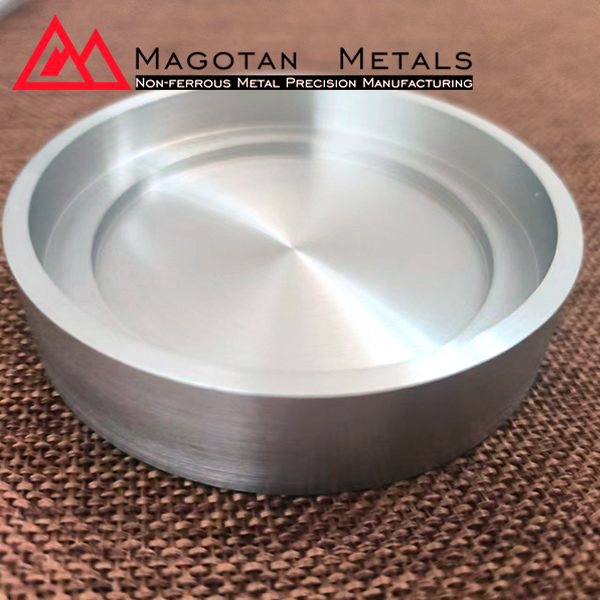
With the rapid development of electronics, jewelry and aerospace industries, the demand for high-quality single crystal diamonds is growing. The chemical vapor deposition (CVD) method is the mainstream synthesis technology, and molybdenum, a transition metal with high melting point and excellent thermal conductivity, plays an indispensable role in this process, directly determining the growth efficiency and quality of diamonds.


I. Adaptability of Molybdenum’s Core Properties: Why It Becomes the Preferred Material for Single Crystal Diamond Growth
Molybdenum’s physical and chemical properties are highly compatible with the strict requirements of CVD-based single crystal diamond growth, mainly reflected in three aspects:
1.1 Ultra-High Melting Point: Resisting Extreme Growth Temperatures
CVD diamond growth requires a stable temperature above 1000-2000°C. Molybdenum’s melting point (2620°C) far exceeds this range, maintaining morphological stability at high temperatures and providing a reliable carrier for diamond seeds.
1.2 Excellent Thermal Conductivity: Ensuring Uniform Crystal Growth
Uniform temperature distribution is crucial for high-quality diamonds. Molybdenum’s excellent thermal conductivity (about 138 W/(m·K) at room temperature) ensures even heat distribution on the substrate, reducing crystal defects caused by temperature differences.
1.3 High-Temperature Oxidation Resistance: Extending Service Life and Ensuring Production Stability
Molybdenum forms a dense oxide film at high temperatures, resisting oxidation and maintaining structural integrity. This extends its service life, reduces substrate replacement frequency, and ensures consistent production quality.
II. The Specific Role of Molybdenum in the Growth of Single Crystal Diamonds by CVD Method
Molybdenum’s role in CVD diamond growth goes beyond being a substrate, covering the entire process of nucleation, growth and quality control.
2.1 As a Core Substrate: Carrying Seeds and Stabilizing the Growth Environment
Molybdenum substrates, with high precision and flatness, securely carry diamond seeds. Its strong chemical stability prevents reactions with process gases, ensuring diamond purity.
2.2 Promoting Nucleation and Growth: Optimizing Crystal Growth Efficiency
Optimized molybdenum surface properties enhance seed adhesion and promote carbon atom adsorption, accelerating diamond nucleation and growth, and shortening the production cycle.
2.3 Quality Control: Reducing Crystal Defects and Improving Product Grade
Molybdenum’s uniform thermal conductivity reduces internal stress and crystal defects. Its high-temperature stability ensures consistent process parameters, improving diamond quality to meet high-end industry needs.
III. Application Expansion of Molybdenum: Adapting to Customized Needs of Different Scenarios
Molybdenum’s high plasticity enables customized applications to meet diverse industrial requirements for diamonds.
3.1 Diverse Forms: Adapting to Different Production Scales
Processed into discs, rods, sheets or complex shapes, molybdenum substrates adapt to both laboratory research and large-scale industrial production, ensuring precise crystal growth.
3.2 Customized Surface Treatment: Adapting to Different Quality Requirements
Custom surface treatments (e.g., precision polishing, coating modification) optimize molybdenum substrates, regulating diamond growth rate and defect content to meet industry-specific quality needs.
IV. Industry Outlook: The Development Potential of Molybdenum in the Single Crystal Diamond Industry
The global synthetic diamond industry is developing rapidly, driving increasing demand for high-performance molybdenum materials. Future R&D will focus on modified molybdenum to further improve diamond growth efficiency and quality.